
Consider a familiar kind of request: “Find a few good products for this client.” A Virtual Assistant starts searching, then needs the quantity, budget, delivery date and preferred suppliers. Twelve product links arrive. You open them all and build the comparison yourself.
The search moved off your desk. The decisions and much of the preparation stayed with you.
A more useful assignment ends with something you can use: three suitable options, the evidence behind them and the tradeoffs you need to decide. That is the starting point for delegation that gives you room to sell, serve clients and lead your business.
Choose a task you can define and review
For a promotional products distributor, good first candidates include a product shortlist, routine supplier follow-up, a draft presentation or a clearly specified record update. Choose work that repeats, has accessible inputs and produces a result you can check. Match it to the person’s skills and the agreed service scope.

An original delegation guide. The examples are recommended starting boundaries, not universal rules or an AndWeSupport service guarantee.
For the first assignment, write down what the person may do, what they should prepare for approval and what requires escalation. The boundary can expand as you see reliable work. It should not depend on someone guessing how much authority they have.
Choose the first task from the work you actually repeat
Review a recent working week. Look for a task that returned to your desk several times and used the same inputs. Start with one output and a manageable batch. “Help with operations” is too broad to review; “prepare tomorrow’s supplier follow-up list with a source and next action for each order” is specific.
| Task | Useful delegated output | Decision to retain at first |
|---|---|---|
| Product research | Three options with supplier links, dated availability, costs and reasons they fit. | Final recommendation and customer pricing. |
| Supplier follow-up | Current status, source, date checked, unresolved issue and next follow-up. | New delivery promises, substitutions or extra spend. |
| Presentation preparation | A draft using the agreed products, client brief and approved visual assets. | Client-facing recommendations and release. |
| Quote preparation | A checked draft using the approved pricing method and clearly listed exclusions. | Discounts, exceptions and final approval. |
| Artwork coordination | Correct proof version routed to the named approver; responses recorded. | Approval of artwork or production release. |
| Customer record updates | Specified fields updated from approved sources; uncertain matches flagged. | Merging ambiguous records or deleting history. |
| Invoice support | A prepared reconciliation or draft reminder with discrepancies identified. | Payments, bank-detail changes, credits or disputes. |
These are possible assignments, not a promise that every Virtual Assistant handles every specialty. Check the required competence, access and scope before assigning work. Financial or contractual decisions should follow your business’s existing approval controls.
Use a small readiness test
Can you show one acceptable example? Can the person obtain the inputs without chasing you? Can you explain what must trigger a question? If one answer is no, repair that gap before increasing the workload. Among tasks that pass, choose one with enough repetition to make the learning worthwhile.
The task owner also needs to accept the responsibility. Atlassian’s roles exercise asks teams to compare expectations, identify unassigned work and agree a primary owner where responsibilities overlap. [1] Apply that principle with the person doing the task, then name the reviewer and backup.
Write a brief that produces a usable answer
Use the example below as a starting point. It is an illustrative product-research assignment, not a real customer order or a claim that suitable products are available at the stated budget. The value is the specificity of the instructions.
Completed example for a product shortlist
Outcome Prepare three drinkware options for an adult employee welcome program. The account manager needs an internal comparison that supports a recommendation, not a folder of product links.
Quantity and budget 250 units. Internal supplier-cost ceiling: $3,750, including product, one-color decoration, setup and freight to one office. Show applicable tax separately. Do not quote a selling price to the customer.
Timing The customer’s required in-hands date is 12 February 2027. Deliver the first research draft by 3 pm Eastern on the second working day of the assignment. Ask for supplier confirmation of timing; label any unconfirmed estimate.
Inputs Use the client brief, approved supplier list, current artwork and the previous accepted comparison. Work from the agreed shared folder. Request missing information in one message before researching.
Required output For each option, include the supplier and product reference, link, image source, quantity pricing, decoration method, setup charge, freight, availability check date and stated production timing. Add the main tradeoff and flag every unknown cost or condition.
Authority You may research and ask suppliers factual questions without committing to a purchase. Prepare the comparison for review. Do not place orders, approve artwork, accept charges, change the budget or promise delivery.
Escalation Tell the account manager if fewer than three options meet the brief, the cost ceiling is exceeded or the timing cannot be confirmed. Present the available choices and the decision needed. Never invent a third option to fill the template.
Completion The account manager can compare all options without reopening every supplier page. Costs reconcile, unknowns are visible, sources are accessible and the draft is saved in the agreed location. The account manager reviews; the named sales backup covers an absence.
Make the question easier to answer
An illustrative escalation might read: “Two options fit the cost ceiling. The third is missing a freight quote, so its total is not confirmed. I can submit two verified options now or continue researching. Which do you prefer? A decision by 1 pm Eastern keeps today’s draft on schedule.”
That message leaves the decision with the right person while completing the preparation. Keep its facts, alternatives and deadline visible; a vague “please advise” sends the investigation back to the owner.
Use the first five days to test the working relationship
Treat the first week as a focused pilot. The schedule below is a proposed review cadence, not an onboarding promise. A complex task, a part-time arrangement or missing access may require more time. Agree the workload and working hours before starting.
| Checkpoint | Work together on | Evidence to review |
|---|---|---|
| Day 1 | Choose one task. Walk through an accepted example and explain the decisions behind it. Confirm access and boundaries. | The person explains the output, allowed actions and escalation triggers in their own words. |
| Day 2 | Prepare a small first batch. Review it against the brief while the work is still fresh. | Inputs used, source quality, completeness and the time spent clarifying the assignment. |
| Day 3 | Revise unclear instructions and repeat with comparable work. Agree a routine update window. | Which questions disappeared after the brief improved and which exceptions still need judgment. |
| Day 4 | Test one realistic exception, such as missing freight or insufficient stock. Use a simulation if necessary. | The exception is identified, evidenced and escalated without an unauthorized promise. |
| Day 5 | Review quality, completion, owner involvement and the person’s feedback. Decide the next scope. | Expand, repeat or narrow the task based on the evidence. Record the decision and next review date. |
Agree how questions reach you
Separate routine questions from decisions that affect a customer commitment. Routine questions can go into a shared list for the next agreed check-in. An exception with an approaching deadline needs the agreed urgent channel and a named backup. State the time zone and response window; “ASAP” does not establish either.
A short daily update can cover completed work, work awaiting approval and blocked items. For each blocker, include the evidence, decision required and latest useful decision time. Use one shared record so the same issue does not create three separate conversations.
Let the brief improve with the person
Ask which instruction was unclear, which information was missing and which step they had to repeat. If an assignment fails, check those conditions alongside the person’s execution. A good pilot exposes gaps you can fix before they affect a larger workload.
Industry experience helps someone understand the context. Your supplier preferences, customer promises and approval rules still need to be taught. Preserve time for that learning instead of treating every early question as a performance problem.
Measure net owner time rather than tasks completed
A busy task list can look successful while you remain the full-time reviewer. Measure the owner time spent on the same completed workload before and during delegation, then check that quality and timing remain acceptable.
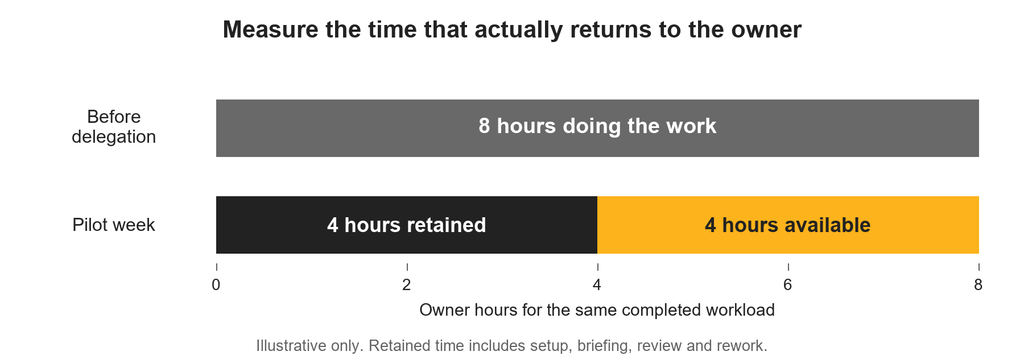
Illustrative calculation only. This compares owner time, not total staff effort, payroll savings or measured AndWeSupport results.
| Owner time for the matched workload | Illustrative pilot week |
|---|---|
| Previous time doing the work | 8 hours |
| Less setup and initial training | 2 hours |
| Less ongoing briefing and coordination | 0.5 hour |
| Less review and approval | 1 hour |
| Less rework performed by the owner | 0.5 hour |
| Net owner time available 8 − 2 − 0.5 − 1 − 0.5 | 4 hours |
Include all owner time spent resolving questions, not just scheduled meetings. Keep the categories separate to avoid counting the same minutes twice. Record the support person’s and other team members’ time separately if you want to assess total business effort or cost.
If setup falls away and the other inputs stay identical, the illustrative recurring result would be six hours. That is a conditional calculation, not a forecast. New tasks, exceptions or higher volume can change it. An early negative result is useful evidence to investigate, not something to hide.
Pair time with quality
Track the share of outputs accepted without correction, completion against the agreed deadline and exceptions raised before a decision becomes urgent. For a small pilot, keep the counts beside any percentage. Faster completion is not progress if missing costs or unapproved commitments create work later.
Build confidence without checking everything forever
Use the pilot to decide how much review the task needs. Review all initial outputs while you establish the standard. If comparable work becomes consistently reliable, consider a defined sample for routine work while retaining approval for decisions that need it. Specify when full review resumes, such as a new task, recurring error or changed client requirement.
Separate a missing instruction from an execution error. Give feedback against the agreed example, explain what needs correcting and let the person update the process with you. Reward appropriate escalation; hiding uncertainty to appear independent is the wrong incentive.
Match access to the assignment
Provide the systems and records needed for the task through approved accounts and permissions. The FTC recommends limiting access to sensitive information by business need and restricting administrative access to appropriate roles. [2] For a product-research pilot, unrelated financial records or payment authority are not part of the assignment.
Document who grants access, what can be shared externally and who removes access when the work ends. Have your system administrator implement the permissions. A written “do not change this” instruction is weaker than an account that cannot make the change.
Decide what should stay with your team
Some work needs direct customer judgment, a physical presence or specialist qualifications. Keep it with the person equipped and authorized to do it. You can still delegate the preparation: assemble the facts, organize the options and prepare the record that helps the decision-maker act.
If every item keeps returning for approval, look at the reason. The person may need a better example, the boundary may be too narrow or the task may require experience beyond the agreed role. Expand authority deliberately after reviewing the evidence, rather than removing review simply to make the time figures look better.
Where AndWeSupport fits
AndWeSupport offers support for promotional products businesses across order management, bookkeeping, research and presentations. [4] Its order-management page includes supplier communication, order tracking and coordination. [3] The relevant next step is to match one recurring assignment to the appropriate service and person.
Bring a recent task, an acceptable finished example and the questions that repeatedly come back to you. Discuss the role, working hours, training responsibilities, review support and backup arrangements. Confirm the actual service scope before expanding the assignment.
Choose one task you want off your desk. Give it a clear output and a decision boundary, then test whether the work leaves you with more usable time.
Plan your first delegated workflow with AndWeSupport
Questions distributors ask about delegation
What should I delegate to a Virtual Assistant first
Choose a recurring task with clear inputs and a checkable result, such as a product shortlist or routine supplier follow-up. Start with a small batch and written decision boundaries. Confirm the person has the skills and access needed for that assignment.
Do I need a complete operations manual before starting
You need enough instruction for the first task: the outcome, inputs, accepted example, deadline, authority and escalation route. Build from that. A long manual that omits the decisions someone must make is less useful than a brief they can apply.
How do I avoid spending all day answering questions
Provide the missing inputs before work begins, group routine questions into an agreed check-in and define an urgent route for time-sensitive exceptions. Review repeated questions to improve the brief. Do not discourage questions that prevent an unauthorized commitment or a costly error.
Can a Virtual Assistant contact suppliers or customers
Yes, where that communication is within the agreed role and authority. Define the information they may share and the commitments they may make. A factual status request and a promise of delivery have different consequences and may need different approval rules.
How quickly should I expect the work to become independent
There is no reliable universal deadline. Task complexity, experience, access, instruction quality and available review time all matter. Use the five-day pilot to identify readiness and gaps. Expand scope based on demonstrated performance, not the date alone.
How do I know whether delegation is working
Compare owner time on similar completed work, including briefing, review and rework. Check quality, deadlines and how exceptions were handled. Record the workload and assumptions so a smaller or easier batch is not mistaken for an improvement.
Sources and method
This guide combines public-source research with an original proposed delegation framework, completed brief and pilot worksheet. The scenarios and calculations are illustrative; they do not represent interviews, a customer trial or measured service outcomes. Sources were checked on 11 November 2026.
[1] Atlassian. Roles and Responsibilities. Supports role clarity and agreed ownership.
[2] Federal Trade Commission. Start with Security A Guide for Business. Supports limiting access by business need.
[3] AndWeSupport. Order Management Services. Supports the bounded order-support description.
[4] AndWeSupport. Homepage. Supports the listed service categories.