
A changed quote can create more work without adding another order. For promotional products distributors, that makes the quote revision process a staffing question as well as a sales task. Before adding support, separate the time spent preparing a revision from the time needed to approve it. More preparation help won’t clear a queue that is waiting for an authorized decision.
Here, a revised sales quote means an updated proposal before order acceptance. Changes to accepted orders should follow your business’s order-change procedures. The focus is the work between a customer’s changed request and a revised offer your team can authorize and send.
What the industry findings show
PPAI’s research on operational adjustments, published February 18, 2026, discusses 2025 conditions and reports increased re-quoting or program changes among 41% of responding PPAI 100 distributors. That combined category doesn’t isolate quote revisions or tell us the staff time involved. The public summary doesn’t establish a representative US or Canadian rate.
Supplier price changes are one possible trigger. SanMar’s pricing terms allow prices to change without notice. Awards Canada’s specification requirements permit a requote when artwork differs from the information used for the estimate. These company-specific conditions explain why an earlier estimate may need another check; they don’t measure how often that happens.
There is also evidence of work around proposals. ASI’s reporting on requests for multiple mock-ups, published October 20, 2026, includes MadeToOrder’s Brittany Frase describing those customer requests. That’s one company’s account of creative work, not a count of quote revisions or confirmation of PPAI’s percentage.
Sources and limits
This is desk research checked November 20, 2026, not original fieldwork. PPAI’s public summary doesn’t disclose the respondent count, weighting, country breakdown or exact fieldwork dates. Supplier terms apply to those companies. ASI provides independent context. Together, these sources don’t establish a current market-wide workload increase or show that your team needs more staff.
Make the quote revision process visible
Our interpretation is practical: include work on existing proposals when assessing sales support workload. First check where your reporting records it. A revision may sit within an existing opportunity rather than appear as a new quote, so new-request counts alone may miss the effort.
Use a consistent unit. One revision cycle takes a changed request through preparation and approval for the next quote version. Several field edits within that request aren’t separate cycles. Track unfinished cycles too, so work awaiting information or review doesn’t disappear from the record.
- Record the change. Keep the customer’s request with the proposal. Specify the changed quantity, decoration, delivery requirement or other condition. A note that only says updated won’t help the next person understand the task.
- Check the affected inputs. Assign someone to obtain current supplier information and flag unanswered questions. Distinguish an estimate from a confirmed fact, especially for availability and timing.
- Prepare a reviewable draft. Show what changed and the information behind it. Quote version control means identifying the current version while retaining the earlier record, so colleagues can trace the revision.
- Approve and release the right version. Follow your company’s authority rules for pricing, margin, terms and customer commitments. Record the decision and the version sent.
Before handing over preparation, define the assignment and approval boundaries. Gathering supplier facts doesn’t authorize someone to make a customer promise. Specify which missing facts or proposed changes must come back for a decision.
If a draft returns for clarification, record the extra effort within the same cycle where appropriate. Five emails about one request aren’t five separate opportunities.
One polo quote, two kinds of work
Hypothetical example: before accepting a proposal, a customer changes the quantity from 300 embroidered polos to 450 and adds another decoration position. Riley prepares the revision; Jordan is authorized to approve it. The quantity and decoration changes require checks before the team can carry forward the original costs or delivery conditions.
Illustrative record for one changed polo proposal
| Record item | Working entry |
|---|---|
| Change | 300 polos become 450, with another decoration position. Keep the customer’s changed request with the proposal. |
| Preparation | Riley requests current product, decoration and freight costs, availability and timing. These remain unconfirmed; no price or date is promised. |
| Review | Pending. Jordan must check the updated cost basis, margin and delivery conditions before authorizing release of version 2. |
| Next action | Riley follows up on missing facts. Jordan reserves review time for the updated proposal. |
Jordan doesn’t yet have a complete proposal to approve. Riley’s next output should show which costs and conditions changed, with gaps clearly marked. If the supplier can’t confirm the second decoration position, the team shouldn’t silently carry the original timing into version 2.
Count staff time without counting it twice
For an illustrative batch of 20 revision cycles, assume each needs 18 preparation minutes and six review minutes:
- Preparation: 20 × 18 = 360 minutes, or six hours.
- Review: 20 × 6 = 120 minutes, or two hours.
- Total: eight staff-hours across the two roles.
These are assumed times, not measured averages or savings. Count each person’s active time once; record waiting separately. Don’t add initial-quote work or existing time entries again. The calculation shows how the assumed effort is divided, not that eight hours of payroll can disappear.
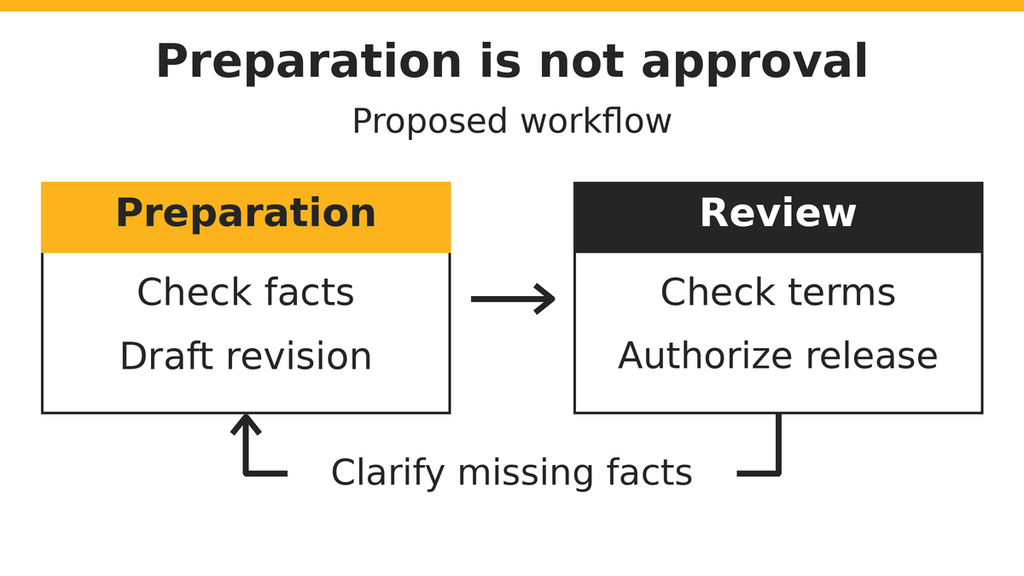
Proposed workflow: preparation supplies checked information; authorized review controls release. Return missing facts for clarification.
Choose the response that fits the constraint
Compare recent requests with similar complexity before changing staffing. Include unfinished work, corrections and deadlines. A fast draft offers little help if the reviewer has to rebuild it.
- Information is missing: improve the request and assign responsibility for obtaining the facts.
- Preparation repeatedly fills the queue: assess whether another colleague can produce a defined output with appropriate training and access.
- Drafts wait for decisions: examine approval capacity, meaning available time from someone authorized to decide. Preparation support doesn’t supply that authority.
- Internal corrections keep recurring: check instructions, source information and training before treating the work as unavoidable customer demand.
In the example, six available preparation hours won’t resolve two hours of review if Jordan has no time reserved. Check both roles’ working hours against the deadline. If supplier answers are holding up the proposal, additional staff effort may not shorten the wait.
If you’re considering a Virtual Assistant, describe the preparation assignment separately from the decisions you retain. AndWeSupport lists estimate preparation and supplier coordination among its services. Confirm the skills, access, scope and review arrangements required for your work.
You may also find that legitimate revisions fit within the team’s available time. That supports keeping the current staffing arrangement rather than assuming every revision signals a capacity problem.
Questions about quote revisions
What should a quote revision process include?
Include the changed request, affected information, current version, responsible preparer, required approval and release record. Keep unresolved facts visible. Another colleague should be able to identify what changed and what happens next without reconstructing the conversation. Use your existing record where possible, rather than maintaining competing copies.
Who should approve a revised quote?
The person authorized for the affected decision should approve it under your company’s rules. A quantity change may require updated costing; a delivery promise may need another check. Assigning preparation doesn’t automatically authorize discounts, substitutions or commitments. Name the reviewer and backup before handing over the work.
Are quote revisions always avoidable rework?
No. Customers can reasonably change quantities, decoration or other requirements, and supplier information can change. Separate those revisions from corrections caused by missing or inaccurate internal information. Both take time, but they call for different responses. Removing legitimate customer choices merely to lower the revision count could undermine the sale.
Can revision counts tell us how many staff we need?
No. Staffing decisions also require records of active effort by role, deadlines, available time and work quality. A simple update and a request involving several suppliers aren’t equivalent. Use your own records to assess a persistent gap. Neither the association finding nor this hypothetical calculation provides a universal staffing ratio.
Start with one recent quote
Take one changed proposal and identify its preparation, open questions and required approval. If preparation repeatedly needs support, discuss quote-preparation support with AndWeSupport. Bring the example and agree who prepares the next version, who reviews it and who authorizes release. Describe the work first, then assess the support it needs.