
Canada Post’s November claim changes affect what customer service teams can say about compensation. Elsewhere, a supplier warning and two distributor announcements raise different questions about payment checks, account economics and commercial responsibility. This edition of promotional products industry news connects five developments to decisions your team can review. AndWeSupport’s interpretation is based on desk research, not field interviews.
PPAI Adds a Customer Care & Support Community
On November 17, 2026, Promotional Products Association International (PPAI) announced three additions to PPAI Communities: Marketing, Human Resources, and Customer Care & Support. The groups serve people with relevant responsibilities or interests at PPAI member companies.
The person answering proof questions and chasing order updates needs development time, too. Check eligibility and nominate someone with a recurring service problem to explore. Then schedule a discussion so colleagues can consider the ideas that person brings back and decide whether to change a procedure.
Keep company-specific customer service training and approval rules in place. The announcement creates an opportunity; it doesn’t demonstrate better service.
Canada Post Changes Peak-Season Delivery Guarantee Claims
Canada Post peak-season changes took effect November 2, 2026, following a September 2 announcement. Its official peak-season notice covers qualifying Priority, Xpresspost and Expedited Parcel items mailed within Canada through January 10, 2027. To qualify for a late-delivery guarantee claim, an item must arrive at least two business days after the delivery standard; other eligibility conditions still apply.
Customer service staff need to distinguish that compensation threshold from the date a customer needs the goods. The rule doesn’t predict a two-day delay for every parcel. Ask the shipping owner to prepare an approved explanation and a separate escalation route for an event deadline. A possible refund won’t resolve the delivery problem.
A Supplier-Impersonation Warning Puts Payment Checks First
Counselor reported supplier impersonation involving Jasper Promotion Corp on November 10, 2026, including the supplier’s denial of affiliation with the impersonator. Individual incident dates weren’t established. This is a specific warning, not a measure of fraud across the industry.
An urgent payment request can arrive while an order is waiting for release. Even then, a familiar supplier name shouldn’t take the place of payment verification. The FBI advises verifying payment requests and account changes using a phone number obtained independently.
Make the division of responsibility clear: who gathers the records, who independently checks changed instructions and who authorizes payment? Assign those responsibilities before an urgent request forces someone to guess.
Stran Reports Higher Gross Margin Alongside Sales Growth
Stran Q3 2026 results, released November 10, 2026, cover the quarter ended September 30, 2026. The company reported year-over-year sales growth of 8.2% and gross margin of 33.3%, versus 27.2% a year earlier. Gross margin is the share of sales remaining after cost of sales, before operating expenses.
Those figures describe financial performance, but they can’t tell another distributor how many support people to hire. These are unaudited company results, and reported financial drivers included customer mix and a tariff refund within Stran Loyalty Solutions (SLS).
For your own accounts, review the economics alongside the work required to serve them. Repeated revisions, unresolved exceptions and frequent senior review deserve attention before you move staff between accounts. Revenue alone won’t show that workload.
BAMKO Creates a Chief Revenue Officer Role
On November 16, 2026, Counselor reported David House’s appointment as BAMKO chief revenue officer, a newly created role overseeing the sales organization and revenue strategy. A separate start date wasn’t established, and the appointment doesn’t demonstrate a subsequent business result.
Smaller distributors don’t need the same title to examine who owns account growth. The practical question is whether commercial responsibility includes a clear connection to the people delivering the work.
Review one sales-to-operations handoff before a new program is promised. Identify who checks delivery capacity and who can resolve a conflict between the proposed commitment and available resources. One person may hold both responsibilities; the team still needs to know who makes the call.
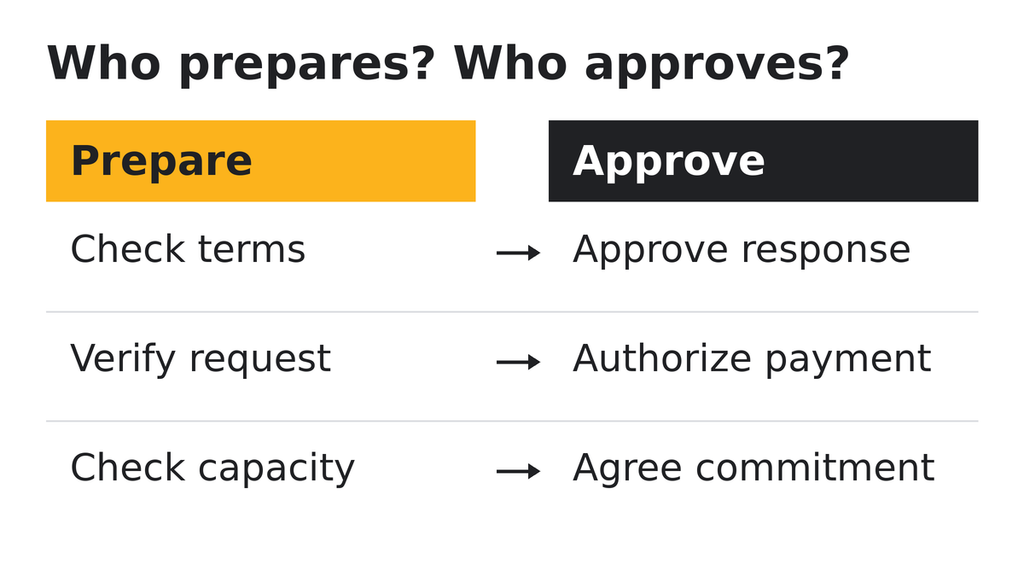
Illustrative review aid: agree who prepares information and who has authority to approve the next action.
Bring one of these updates to your next team meeting with a specific instruction to review. Agree who owns the follow-through and who approves exceptions. To explore support for that workflow, discuss your team’s support responsibilities with AndWeSupport.